
Prints and dances based on the radio experiments of Juan de Loxa
Duration: 60 minutes
Premiered at the Seville Flamenco Biennial 2020
Central Theatre
A flamenco projector, more than a project, by the dancer Leonor Leal.
(For Juan de Loxa, a girl)
What began to emerge in the investigations of Leonor Leal and her interlocutor, Juan de Loxa, was something more than an investigation, it was love at first sight. Juan loved her head, her hair and her dancer's walk, all in the same package. "Oh! If only I could tell Pilar!" and he was referring to Doña Pilar López, the great dance teacher after the Spanish Civil War. (…)
Juan de Loxa represents not only the interplay of the three elements, the avant-garde, the cultured and the popular, but also his way of understanding all three at once, without commas or full stops. And that, there it is!, is what caught Leonor Leal in the net. She was at that same crossroads of paths, the popular, the avant-garde and the cultured, and she tried it out and looked for it, but suddenly, she found it like that, all at once and without separations. That was exciting. To be able to hear it from such a lively voice in a tired body, that was a delight, a special moment of affection.
“Meeting certain people in life can open a window, a door or your mind if there is a click. Juan de Loxa corresponds to the latter for me.
Poet, creator, intellectual, flamenco, speaker, promoter, generator of ideas, mobilizer of fantasies… His humor, his eloquence and his versatility captivated me. Meeting him made me feel at home. We shared long conversations and I planned a thousand things to see together. He was a late and fleeting friend but he left my neurons dancing. So much so that in this proposal I allow myself to continue talking with him, in some way, even though he is no longer here. My curiosity about his proposals on what he called “Jondismo” or the penultimate -ism of the avant-garde is so great that I embark on this challenge knowing that a thousand things will surprise me.
This show is based on my desire to know him even more, not only to remember him but to continue creating from him and to touch, perhaps, the roof of a circus tent or the roots of his raw and hairy Andalusia.
Leonor Leal
Artistic file:
Direction, choreography and dance: Leonor Leal.
Apparatus and artistic consultancy: Pedro G. Romero.
Collaboration in the direction: Maria Munoz and Pep Ramis (Bad Hair).
Percussions: Antonio Moreno (Lorca Project) /Saxophones: Juan Jimenez (Lorca Project) /Sing: Thomas Perrate /Guitar and singing: Maria Marin /Guitar: Salvador Gutierrez
Lightning: Carmen Mori
Soundtrack: Fanny Thollot (from original audios from «Poesía 70»)
Projected images: Raul Guridi
Texts: original scripts by Juan de Loxa for «Poesía 70» and fragments of the prologue of the poetic anthology «Jondos 6», written by Miguel Romero Esteo in 1975
Costume design: Marlota, Teresa Baena and Carme Puig de Vall i Plantés
Sound technician: Manu Meñaca
Technical video: Fernando Brea
Production: Leonor Leal & A Negro productions (Cisco Casado)
With the collaboration of the Ministry of Culture – INAEM, Andalusian Institute of Flamenco of the Andalusian Government, Utrera City Council and San Jose de la Rinconada City Hall.
Leonor Leal, a restless and personal dancer if ever there was one, met the poet and intellectual from Granada, Juan de Loxa, in her later years (he died in 2017) and was so fascinated by his personality that she did not hesitate to pay tribute to him, which, given the stature of the figure, may not be the last.
A risky project, since every homage creates expectations in the viewer that are difficult to fulfill, even if they warn that it is not a biographical sketch.
In fact, after seeing the show, those who did not know him will know little about him, except that he had a provocative and successful radio programme entitled, like his magazine, Poesía 70 (Ondas Prize 1982). And those who knew him - those of us who knew him - will always miss everything that is missing, which is a lot, since one cannot summarise in one hour the political, literary and human dimension of an intellectual who fought at the end of Franco's regime to transform Andalusian culture. There remain, as spearheads, the testimonies of Morente and Mario Maya, for whom he wrote the lyrics for his emblematic shows Ceremonial and ¡Ay, Jondo!
If we put that difficulty aside, Loxa is presented as a simple show, with the same stage approach as Leal's previous work, Nocturno, that is, with a rectangular floor and a wall in the background, this time a large screen on which images are projected, many of them alluding to the poet, like the proverbial 'se proive el cante'). On stage, a table with wheels full of papers and some elements that can be easily moved in the development of an action that simulates a radio broadcast - 'here Radio Bienal', says Tomás de Perrate, turned into an improvised announcer - punctuated by musical numbers.
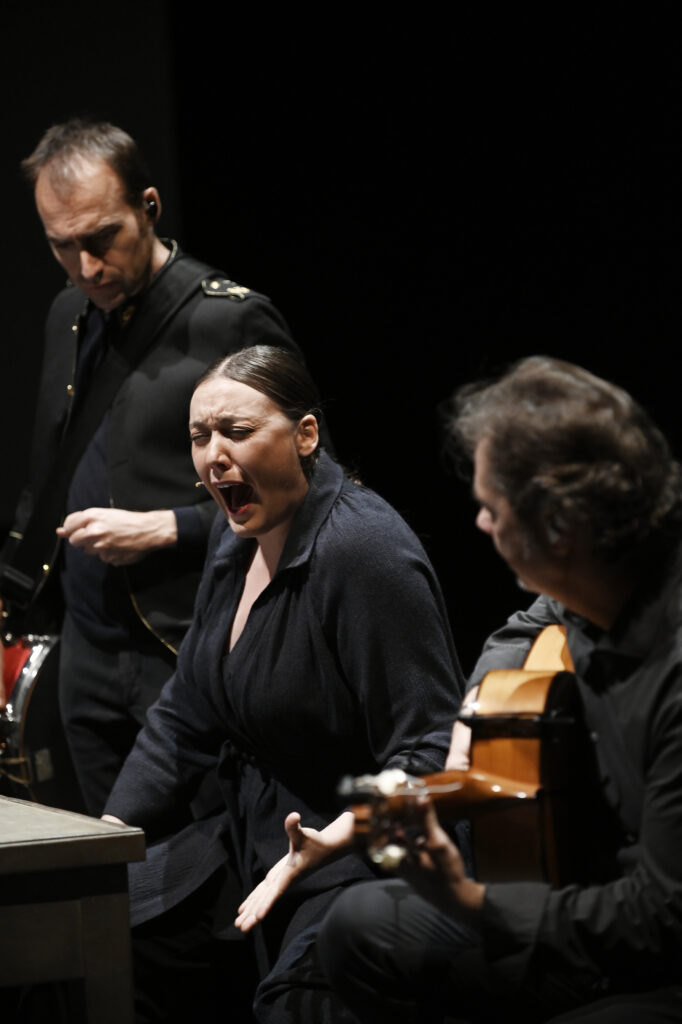
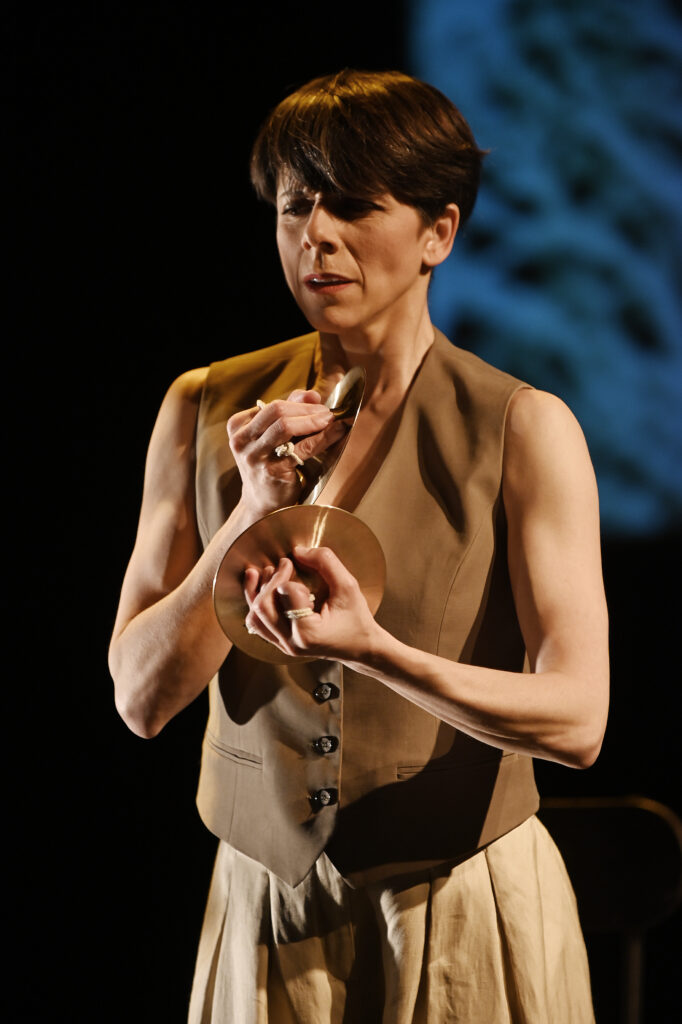
The common thread, then, is that theatrical and repeated formula, executed by the musicians with dignity and sometimes with grace, as with the satirical poem by Loxa recited by Antonio Moreno. The stage movement is clean and enriching. And that's not to be missed, knowing that the founders of the Malpelo company, María Muñoz and Pep Ramis, have collaborated again. However, what really convinces about the proposal is its musical and dance framework.
Popular music, like the beautiful granaína played by Salvador Gutiérrez, and more contemporary music by the members of Proyecto Lorca. There is even a porteño tango sung in the strong and always impressive voice of Perrate. The cultured and the popular giving way to the avant-garde, as the poet from Loja would say. Also wonderful is the contribution of a classical guitarist from Utrera, María Marín, who delves into flamenco with a great presence and a beautiful voice that she is still trying to establish.
In the middle of them all, Leonor Leal from Jerez, living in Utrera. Luminous, lively, sensual in her almost androgynous appearance - with her short hair and her suits -, a dancer and flamenco dancer, as well as a writer of short stories.
Despite her already noticeable pregnancy, Leal offered a real dance recital. Subtle and very flamenco at the same time, she naturally walked around the space seeking the complicity of each one of those present. With her quick feet, she dialogued and improvised new scores with Moreno's percussion or Jiménez's saxophone, showed off her dancer's wings in a beautiful duet with Marín, gave herself over to the taranto with flamenco care and, finally, with enormous joy, gave us a fragment of those devilish cantiñas that she surely danced with Mario's spirit on her head.
If there is a flamenco artist who represents twenty-first century art in all its dimensions, it is Jerez-born Leonor Leal. Descriptive and disruptive, she presented Loxa last night at the Teatro Central in its world premiere, a tribute to the Granada poet Juan de Loxa, whom she considers to be a Falla and Lorca of the seventies, to his radio programme Poesía 70, to Mario Maya and the innovation and break with Francoist flamenco that Camelamos Naquerar represented. To everything that represents flamenco as a whole, not as a series of parts.
For Loxa, he wanted to count on the artistic advice of Pedro G. Romero and the collaboration in the stage direction of Mal Pelo. His artists, the usual ones of Proyecto Lorca, Antonio Moreno on percussion and Juan Jiménez on the saxophones. The guitar of Salvador Gutiérrez. Tomás de Perrate who here, in addition to singing everything, acts as a radio presenter. And the priceless presence of María Marín, a Utrera native living in Holland, trained in classical guitar and reconverted into flamenco guitar and singer by vocation and the demands of the script. And she does it in such an outstanding way that it distinguishes her as a protagonist.
Leonor is complex, as all research work requires. You have to know in advance what you are going to see if you want to follow the thread of what is happening on stage. You have to know Juan de Loxa and his radio activism, which Leonor learned about in conversations with this flamenco poet who passed away in 2017. That beginning that narrates the internal process of a radio program, here Radio Bienal, with Tomás de Perrate as host and the sounds of the program as they are produced in the depths of the studio. The intention is more than biographical, it is at times rather satirical.
Leonor, the image of the break with traditional flamenco, dances in the beautiful white suit and trousers and with the short hair that is already characteristic of her in Nocturno. We are in a space of freedom that sometimes goes back to the 1930s, when flamenco was mixed with other music in those cafés that disappeared when the tablaos appeared in the 1950s, in the midst of Franco's regime. And so Tomás de Perrate, who dares to do everything and does everything well, sings, among other things, a Buenos Aires tango.
No wonder Loxa is subtitled Estampas y bailes (Stamps and Dances) after those radio experiments aimed at transforming Andalusian culture in the late Franco era of the seventies, a creative era that has not been repeated, perhaps because that circumstance is unrepeatable. That's where Mario Maya comes in with that descriptive ¡Ay! on the background screen.
Leonor Leal has once again opted for a minimal stage, as if she wanted to demonstrate that what is important on stage is the flamenco and contemporary music and the dances, with a cultured and popular framework always at the forefront.
And in the middle of it all, with a constant presence on stage, Leonor, dancer and bailaora, in masculine and feminine, with touches of humor, sensual at times, always innovative. Her dance is comparable to series of corporal experimentation of new dance forms that always bear her own seal of identity. She does not look like anyone, perhaps she does not even pretend to look like herself. She is continually telling us that dance is the language with which she expresses herself, that each situation requires a movement that describes it. Always complicit with her artists, she dialogues with each one of them, very flamenco with the guitar, new forms with those of Proyecto Lorca. And outstanding in that prodigious duet for taranto with María Marín, which can be described as the cherry on the cake that could not be missing, because without that image the show would be incomplete.
The duet with María and then the finale with all the artists in a flamenco group to support her in the final filigree, perhaps reminiscent of Mario Maya with some very personalized cantiñas and alegrías overflowing with flamenco. For these final scenes, the dancer dressed in black, trousers and a top.
And now, after the joy of the world premiere at the Bienal, there remains the complicated task of taking the show to other theatres in Spain and abroad in these unpredictable times when the only thing that is predictable is the long term. I wish they were at the Suma Flamenca in December or in any of the dance cycles at the Teatros del Canal or at the Nîmes Festival in January or in Jerez in February… But there is another very happy circumstance: Leonor Leal's upcoming motherhood.
Teresa Fernandez Herrera – Here Madrid – 07/09/2020
Seville Biennial 2020: Leonor Leal's experimental theatre
Leonor Leal premieres her latest proposal at the Biennial, which pays tribute to the memory of the poet and cultural activist Juan de Loxa.
Known for the radio programme 'Poesía 70' which gave voice to the young poets of that generation, Juan de Loxa, poet, intellectual and cultural activist, was an avant-garde artist who vindicated popular culture. Leonor had the privilege of sharing many sessions with him at the table that left her, as she herself has declared, "her neurons dancing". With this show she pays him a unique tribute that is loyal to her investigative zeal and to the principle of creative freedom that the artist transmitted to her.
If anything defines Leonor Leal, it is her research, which ultimately responds to the need to find a bridge between traditional flamenco and her avant-garde concern. Perhaps that is why the figure of Loxa fascinated her from the beginning. He promised to write something for her, but death took him away before he could keep his word. For all this, Leonor, although part of the artist's memory, aspires to define an exercise of her own creation. But yes, supported by a staging that refers to the radio program that made Loxa popular.
In this way, Tomás de Perrate becomes a radio announcer who envelops us in a blanket of poetry with his shrill voice; Juan Jiménez changes the saxophone for the microphone to recite a poem of avant-garde style; and the musicians of Proyecto Lorca sing a musical piece based on whispers, clicks, and the sounds of a fan that in Leonor's hands marks the beat as well as a closing or a snub.
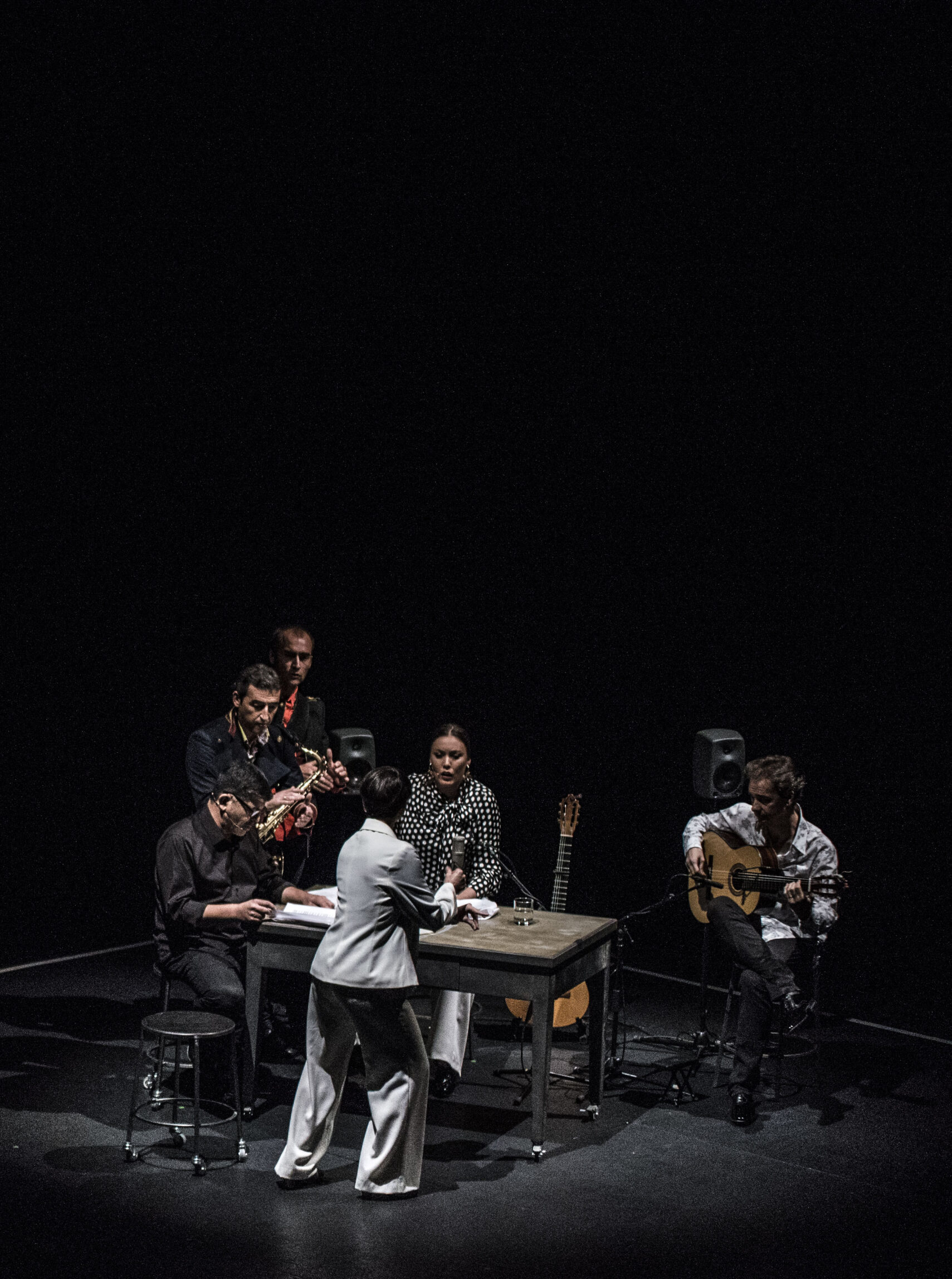

All this determines a stage space that is unusual in the flamenco universe, which manages to transmit closeness and strangeness at the same time. Although what really captivates us is the forcefulness and cleanliness of her heel-tapping in the tarantos; with the sweetness and emotion with which she touches us when she is alone with María Marín, who sings to her and while she plays the guitar with a picture that refers to the Serneta; and above all with the final alegrías, with which Leonor manages to fill the stage with light dressed in strict black.
Due to the fragmentary cut imposed by the staging, the rhythm of the show is somewhat irregular, although it picks up towards the middle when flamenco takes over the discourse and we can delight in the masterful playing of Salvador Gutiérrez; the old-fashioned singing of Tomás de Perrate; the sweetness of María Muñoz's voice, a real find for a singer, and the power of a Leonor Leal as defiant as she is joyful.
This past Saturday, September 26, dancer Leonor Leal took to the stage at the Teatro Central in Seville to present Loxa, her latest creation.
Leonor undoubtedly offered one of the most interesting and brilliant performances of this Seville Biennial. Dance, theatre, poetry, good singing, emotion... Loxa was a perfect show. An unforgettable night for those of us who were there. The audience stood up and gave it a warm and prolonged final applause. Her refined technique is combined with a restless and creative sensitivity that makes her travel to magical places, such as in this case poetry and the figure of Juan de Loxa. A true demonstration of maturity, elegance, and mastery. A refined dance, but full of spark and duende. It is not a strident, rapturous duende; rather, Leonor's duende is a poet duende, in love with beauty, who flees from the vacuous or conventional. At Aforo Libre we wanted to take the opportunity to chat with her, and find out a little more about this couple: Leonor Leal / Juan de Loxa.
Open capacity: Hello, Leonor. We are very happy to be able to chat with you. And that you have found a little time for us, right after your visit to the Biennial. How would you introduce yourself to those who still don't know who Leonor Leal is?
Leonor Leal: Well, I would say that I am a dancer with many other artistic interests and a great drive to always want to learn. This combination leads me year after year to get into all kinds of trouble.
TO THE: How did you get into flamenco? Tell us a little about how your vocation for dance was born.
LL: Well, in my house there is no one who is dedicated to art, but they supported me from a young age to take dance classes and to train in what I liked most: music and dance. I still remember when my mother saw an advertisement for a school in the newspaper and called on the phone. She signed my sister and me up and from the first day of class, I felt that it was my place with a certainty that surprises me still. In fact, I refer to that feeling very often.
I started with classical dance, piano and Spanish dance. Then I discovered flamenco and that's when I needed to dedicate myself more. I wanted to achieve that freedom that flamenco gave me.
TO THE: Is there anyone in particular who you would highlight for having given you that passion for dance, for the stage?
LL: My first ballet teacher, Belén Fernández, was key for me. I connected with her and with her passion. With her pedagogy so fair and so coherent... her energy was and continues to be admirable. She taught me the spirit of improvement and the love of dancing and feeling the music as well.
TO THE: Who has inspired you? Who would you say have been your teachers?
LL: My teachers in my more professional stage have been all those with whom I have worked. I learned a lot from all of them and very different things. It is true that I spent more time with Andrés Marín so I have a lot to thank him for. I would say that all my rhythmic materials are very based on him. And now, I am very focused on the more scenic part of the projects so María Muñoz and Pep Ramis, two veterans of dance in this country (Compañía Mal Pelo) are my guides and my mentors.
A personal path of growth.
TO THE: What would you say flamenco is for you today?
LL: It is a personal path of growth and discovery. It is a long journey and that keeps me going and of course it has become a way of life and a means of support.
TO THE: Just a few days ago you performed at the Teatro Central in Seville with 'Loxa'. How did this latest work come about?
LL: I met Juan de Loxa a few years ago, when I was looking for information about his collaboration with Mario Maya in the 70s. I wanted to know first-hand what those stage experiences were like, which I never got to see live. Juan had written the script for Ceremonial and Ay Jondo! (two very important shows by Mario for me). And I found an extremely interesting man. Full of anecdotes to tell me, with an immense culture and knowledge, with humor, with a passion for culture... we became good friends and had long talks that were worth their weight in gold. I discovered his generosity and everything he had contributed to so many artists of the time. Juan kept intact his ability to inspire whoever approached him and so it happened with me too. More than a homage or tribute to him, I wanted to do something under his impulse and that is how I started with this show.
TO THE: It is a very personal project, in which you are in charge of direction, dance, choreography and production. But you are not alone. You are very well accompanied. Tell us a little about your companions on this journey.
LL: Well, I have a very well-chosen cast, thinking about Loxa's versatility. I have Proyecto Lorca, made up of Antonio Moreno and Juan Jiménez, who will cover the more experimental and contemporary music part. I have the masterful guitar of Salvador Gutiérrez (who played for Mario in his time and is therefore a musical reference that I needed), with Tomás de Perrate, whose voice, besides being Jonda, is perfect for Buenos Aires tango or to recover Gillespie in a vocal version that suits him perfectly, and finally I have María Marín, a guitarist and singer from Utrera who has been living in Holland for years. She has a great presence and a lot of talent and I asked her to compose a version of En un sueño viniste (which Morente sang). The result is a piece full of sensitivity, and I needed that sweetness in the show as well. There is a bit of everything, and above all there is a very high professional and human level! What more can I ask for?
Concern and curiosity
TO THE: Do you think there is a special way of living flamenco in you? Do you think it shows something about you, about who you are?
LL: Of course... I suppose there are even aspects that just come out and that I myself am not aware of. Almost no one likes to define ourselves, but if there is one thing I am proud of, it is my restlessness and my curiosity to know and discover.
TO THE: What do you think about the situation that flamenco is experiencing in these times of pandemic?
LL: Everything that was not working well before the pandemic has come to light, and not only in flamenco. It is a good time to put things in order. Unity within the profession is necessary to have a voice, and I think that this circumstance is a great opportunity for that.
TO THE: This peculiar and strange Flamenco Biennial has come to an end. How would you rate it?
LL: I don't usually see anything before my own premiere and I'll enjoy what's left once I've calmed down about my own thing. Regardless of my colleagues' proposals, I think this Biennial has been an achievement for everyone and a very big challenge. I see it as positive that 100% have fought tooth and nail to keep it going at this time.
TO THE: We have a habit of asking the interviewee to make some cultural recommendations. Are you up for it? Any shows, books, albums... that we shouldn't miss?
LL: Book: Pages of the Wound (John Berger). Album: Dani de Morón's new album, which I'm just discovering today. Show: Any work by La Zaranda, Teatro Inestable de Nadie Parte.
TO THE: Congratulations on your work. We will be looking forward to your next appointments. And we hope that one of them brings you to Malaga. It has been a pleasure to chat with you and to find out a little more about you.
LL: Thank you all!! Delighted to meet you.
Manuel Malaka – www.aforolibre.com – 03/10/2020
Utrera – Seville.
+34 606 892 717


Utrera – Seville.
+34 606 892 717 – +34 665 680 058